July 10, 2016
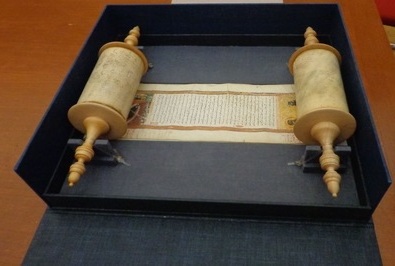
The Pierpont Morgan Library & Museum in New York City has a large collection of illuminated manuscripts. Among them is the manuscript 499, a parchment roll of about 3.3 m long and nine cm wide. Its skin-side is written in Greek with twenty illuminated miniature scenes depicting the Legend of King Abgar, its hair-side is a translation of the Greek text in Arabic with no miniatures, although a cross is drawn on the hair-side on the segment kept at the University of Chicago (see below). Its production has been dated in the third quarter of the fourteenth century, but certainly not later than 1383, because the author of the Arabic text states that year for his translation. The roll was an amulet. Originally, it was likely owned by a Byzantine military officer, then in 1383, owned by a Christian, Suleyman ibn Sara, because the colophon of the Arabic text says so.
 |
|
Figure 1: The parchment roll 499 of the Morgan Library & Museum. The Greek
text and two partial miniatures are visible. The Arabic text, on the hair side of the parchment, can
be seen on the rolls.
© The Morgan Library & Museum, New York City. Photograph by Mario Latendresse |
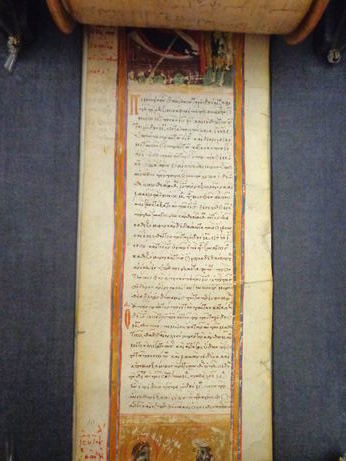
Figure 1 shows the scroll mounted on two custom-made rolls in a protective case. For its age, the manuscript shows remarkable good conservation, although the miniatures have lost some paint. The tiny Greek writing is still crisp and clear, see Figure 2.
 |
|
Figure 2: The Greek text of the Abgar legend with two partial miniatures.
© The Morgan Library & Museum, New York City. Photograph by Mario Latendresse |
As part of the Legend of King Abgar, Christ sends an image of himself to King Abgar. That image is known as the Image of Edessa also known as the Mandylion. Actually, the legend evolved from an image painted by a messenger sent by King Abgar to an image made by Christ himself. The Mandylion can be seen in several of the miniatures of M.499. Because this manuscript M.499 was produced after the sack of Constantinople in 1204, it is almost certain that the artist who created the miniatures never saw the Mandylion itself. Furthermore, the manuscript was probably produced in Trebizond, if not, it was in Constantinople. Actually, one may ask the general question: had any artist, who reproduced the Mandylion, seen the real Mandylion before the sack of Constantinople? The answer is likely negative. The many artistic representations of the Mandylion that we still have today are probably based on hearsay and on the legend of King Abgar. Manuscript M.499 would be a documentary evidence supporting this claim, because we can see in it the typical artistic reproductions of the Mandylion similar to many others produced before 1204, yet the artist of M.499 can hardly have seen the real Mandylion.
The twenty miniatures of M.499 can be seen on the website of the Pierpont Morgan Library. The manuscript is divided in twenty sections, each with a miniature scene. In the entire manuscript, four scenes show clearly the Mandylion, where only the head of Christ is visible, and one scene where the Mandylion is mostly hidden:
- In Section 9, Ananias receives the image of Christ on a cloth, i.e., the Mandylion, directly from Christ;
- In Section 10, the Mandylion, on its journey from Jerusalem, is temporarily hidden between two bricks;
- In Section 11, the Mandylion is being revealed after it was temporarily hidden;
- In Section 12, the Mandylion is in a scene of a miraculous healing;
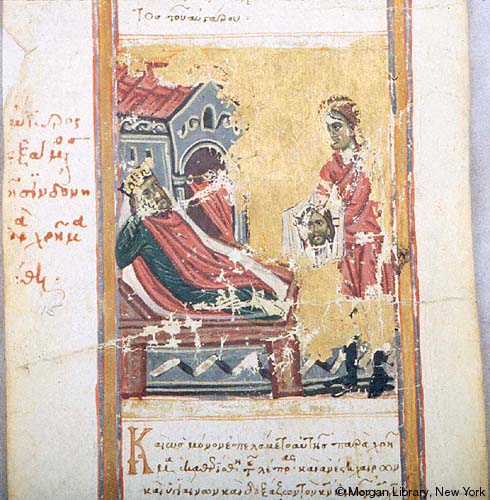
- In Section 14, Ananias reveals the Mandylion to King Abgar. See Figure 3.
 |
|
Figure 3: Miniatures of Section 14 in manuscript M.499. Ananias reveals the face of Christ on a cloth to King Abgar. The cloth is known today as the Mandylion/Image of Edessa.
© The Morgan Library & Museum, New York City. |
The roll is incomplete because the beginning segment is missing and it is kept at the library of the University of Chicago as manuscript 125. That segment is about 1.7 m long with seven miniatures representing Mark, Luke, John, Christ, Christ and the Virgin, the Trinity and David as King of Israel. The Chicago fragment does not contain any scene involving the Mandylion.
For a good description and analysis of the manuscript M.499, see [1], which has a lengthy bibliography.
The Mandylion/Image of Edessa was most likely a real cloth with an image of Christ, which is transferred from Edessa to Constantinople in 944. It had been kept in Edessa for many centuries. When the Image of Edessa arrives in Constantinople, it is kept in the Imperial Palace and hidden from public view. Its whereabouts is not clear after the sack of Constantinople in 1204, but it is likely transferred to the Sainte-Chapelle of Paris in 1241 after Baudoin II, the desperate Latin Emperor of Constantinople, sold twenty-two relics to King Louis IX. Indeed, the inventories of the Sainte-Chapelle describe a reliquary with a face of Christ at the bottom and containing a cloth.
The manuscript “Pour scavoir la verite,” written around 1525, says that the shroud of Lirey, today the shroud of Turin, was received from King Philip VI. The simplest explanation for the provenance of that gift is the Sainte-Chapelle of Paris, because that is the main repository of the relics of Christ of the King of France. The only relic of the Sainte-Chapelle of Paris that can correspond to the shroud of Turin is the Mandylion.