Dec 24, 2016
In the notice Pour scavoir la verite, written around 1525 by one of the canons of the collegiate at Lirey, its author states clearly that the Shroud, known today as the Shroud of Turin, was given by King Philip VI to Geoffroy de Charny for his tentative to regain the city of Calais on the first day of 1350. The tentative was not successful, and Geoffroy was captive for 18 months in London. On his return to France, did Geoffroy finally brought the Shroud to Lirey? That would have been in mid 1351. Was Geoffroy even aware of the presence of the image on the Shroud by this time? A few years later, the Shroud was publicly exposed at the small wooden church of the collegiate at Lirey.
How did King Philip VI obtain the Shroud?
All evidences show that we do not have to look further than the private collection of the King: the relics kept in the Grande Châsse at the Sainte-Chapelle of Paris. It was the most prestigious collection of relics in Christendom. We still have the inventories of the relics taken over several centuries. The inventory of August 1740 reveals that the reliquary where a cloth had been kept, had lost its content. That cloth was the Mandylion of Constantinople. The description is all about the reliquary and of a portrait of Christ at the bottom, a Veronica. The officials making these observations do not identify any cloth. They do not indeed separate the presence of the Veronica from the reliquary because the Veronica is described as appearing directly on the bottom of the reliquary. That Veronica is not described as being on a cloth. And none of the previous inventories, up to 1534, describe the image on a cloth. All appearances show that the cloth had disappeared before 1534.
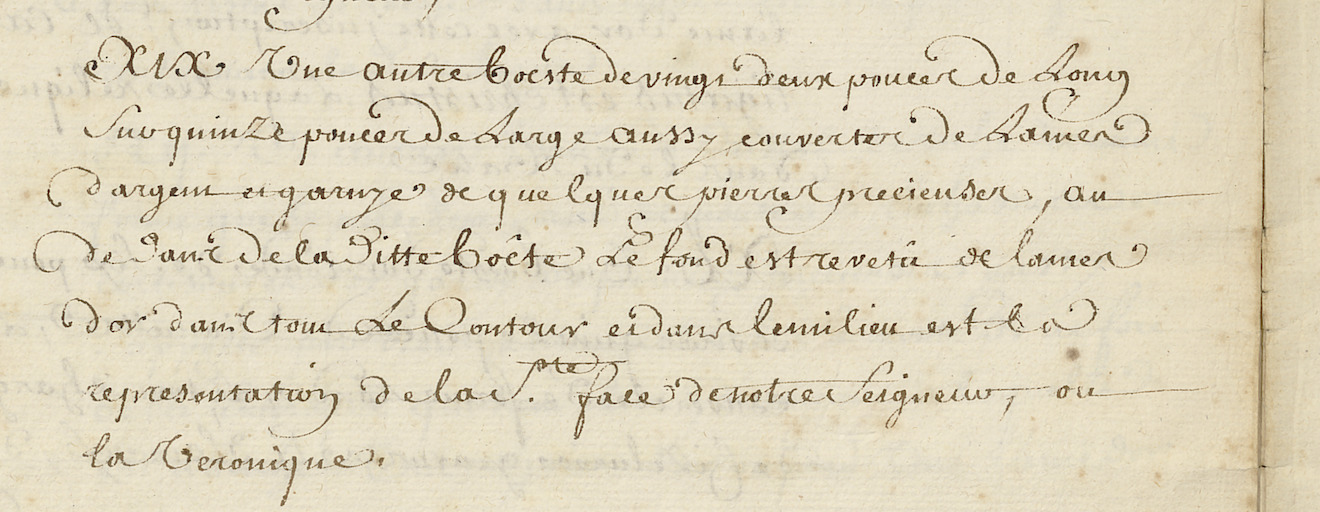 |
| Figure 1: Item 19 of the August 1740 inventory of the Grande Châsse at the Sainte-Chapelle of Paris. The French text describes the reliquary in which a cloth had been inserted when it arrived in Paris in 1241 (“Sanctam toellam, tabulae insertam” as given by the 1247 official letter, signed by the Latin emperor of Constantinople, Baudoin II, ceding the relics to Louis IX, King of France). The reliquary is a rectangular box of about 60 cm by 40 cm, and has a portrait of Christ's face on the bottom with golden plates all around it. However, in this inventory, no cloth is mentioned. (Click the image for a larger view) |
Figure 1 shows an extract of that inventory. The manuscript is kept at the National Archives of France (Archives nationales de France (AnF)). It is item 19 of a list of 21 items.
Remarkably, right after the description of item 19, item 20 refers to a reliquary containing hairs of the Virgin, the same type of relic deposited at the church of the collegiate at Lirey. Figure 2 shows an excerpt of the manuscript describing this reliquary containing the hairs of the Virgin.
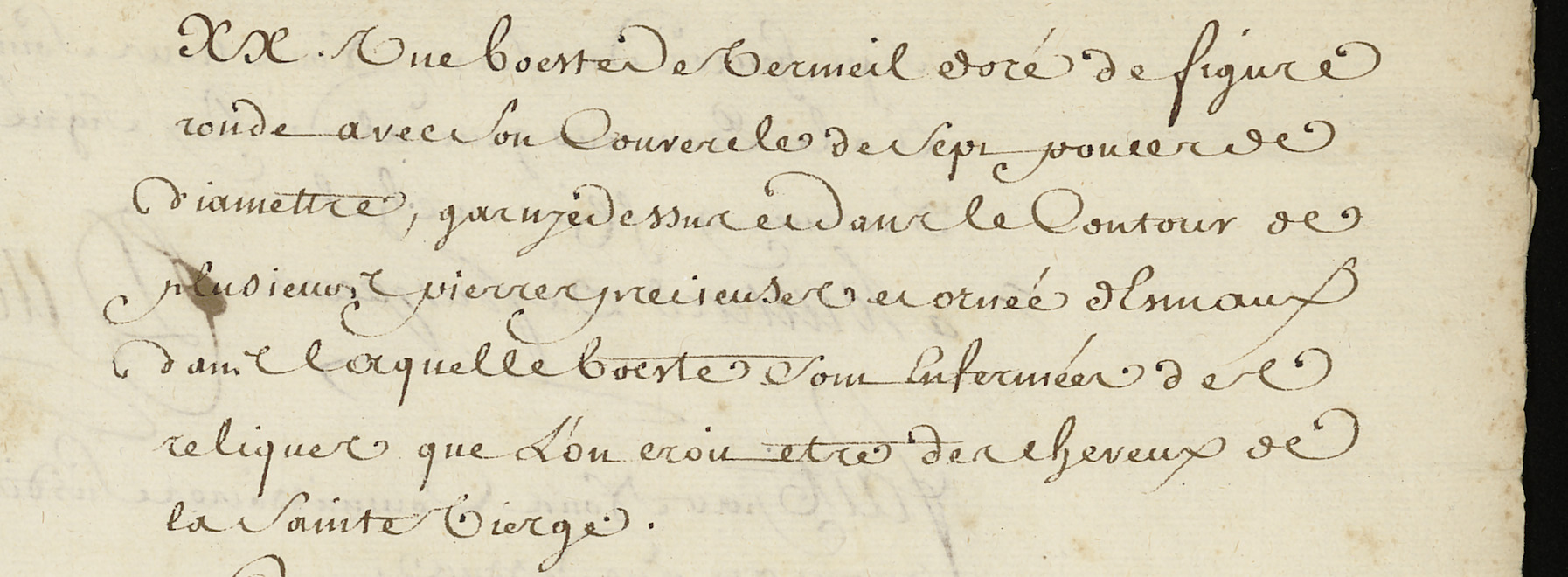 |
| Figure 2: Item 20 of the August 1740 inventory of the relics from the Grande Châsse (Archives nationales de France, AnF). It describes a reliquary containing what is believed to be hairs from the Virgin. (Click the image for a larger view) |
The third relic deposited in the church at Lirey was a piece of the True Cross, which was also a relic in the Grande Châsse. King Philip VI had complete control over the relics and he could use this collection according to the need of the Kingdom. Accordingly, the simplest and most natural origin of the three relics of Lirey, including the Shroud, is the Sainte-Chapelle of Paris.